top of page

Baluchari sari
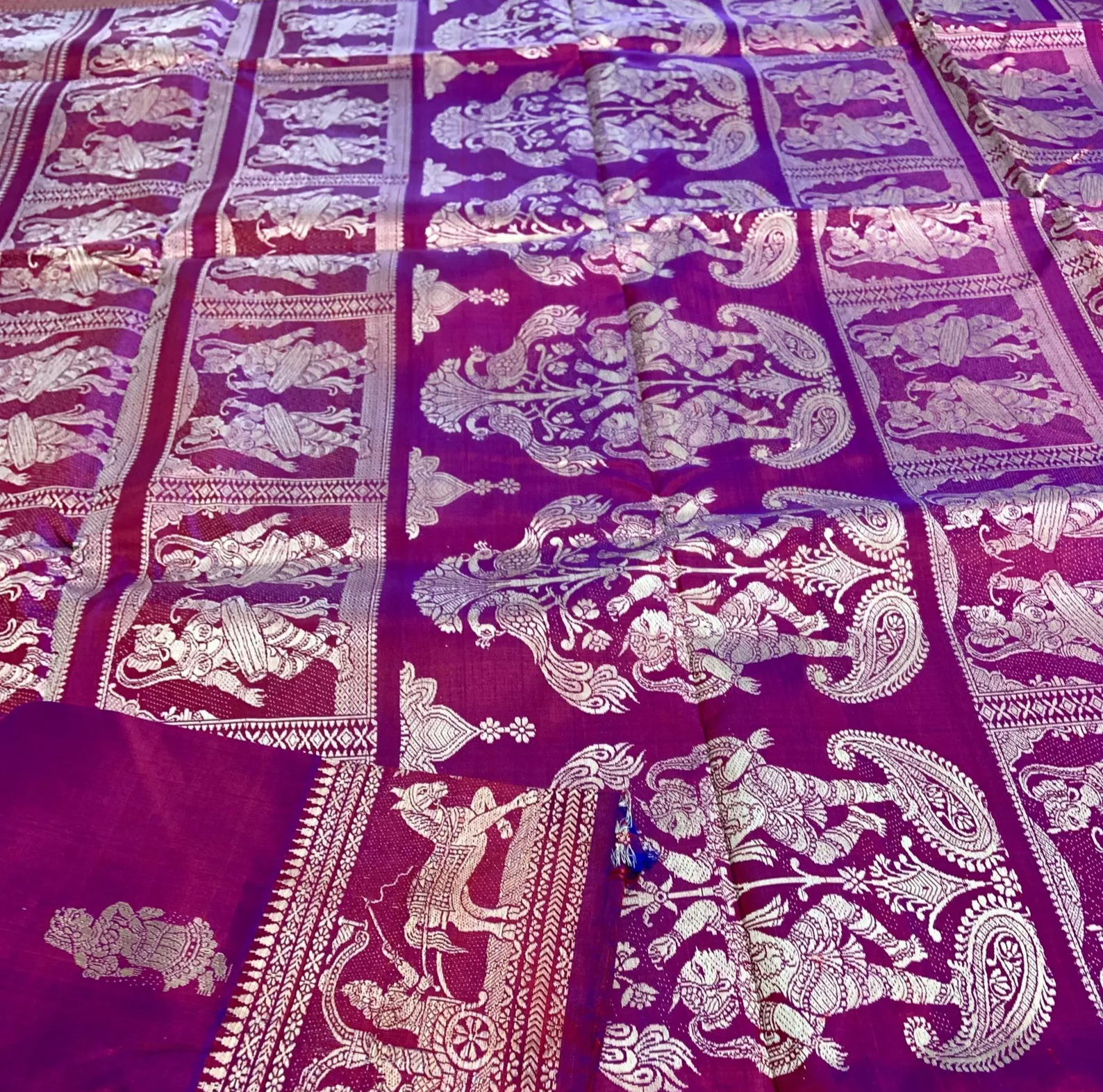
When you add a baluchari saree to your collection, you are not just acquiring a piece of clothing; you are embracing seven yards of India's intricate and vibrant history. Baluchari sarees, renowned for their stunning borders and pallav, showcase stories and imagery from ancient epics and sacred texts. Their luxurious nature makes baluchari sarees perfect for celebrations, weddings, and significant events.
Types of Baluchari
Although there isn't much variation in the silk type or weaving technique used today, balucharis can generally be classified based on the threads employed in creating the patterns:
Baluchari (resham): The most basic balucharis feature resham threads in a single hue to craft the entire design.
Baluchari (meenakari): These balucharis incorporate threads in two or more colors, enhanced with beautiful meenakari work that adds vibrancy to the patterns.
Swarnachari (baluchari in gold): These are the most stunning balucharis, crafted with gold or silver-colored threads (often adorned with meenakari work in a different color) that significantly enhance the patterns' brilliance.
The price of a baluchari saree is influenced by the cost of these threads and the complexity of the designs.
Brief History
The history of baluchari sarees dates back more than 200 years to the 18th century, when the Nawab of Bengal, Murshidkuli Khan, introduced this craft from Dhaka (now in Bangladesh) to a small village called Baluchar, located along the banks of the Bhagirathi river in Murshidabad (West Bengal). The term 'baluchari' is derived from 'balu' (meaning sand) and 'char' (river bank). During this initial period of baluchari weaving, the themes depicted the lives of the nawabs, showcasing women smoking hookahs, nawabs in horse-drawn carriages, and even European officers from the East India Company. The art thrived in Baluchar until the shifting courses of the Bhagirathi river forced villagers to relocate repeatedly. Ultimately, a flood of the Bhagirathi led to the relocation of the trade from Murshidabad to Bishnupur (in the Bankura district of West Bengal) in the 19th century. There, the trade prospered for a time under the Malla dynasty, until the British, feeling threatened by their inability to replicate this craftsmanship in English mills, imposed financial sanctions that nearly drove the impoverished weavers out of their trade, pushing it to the brink of extinction.
The resurgence of baluchari weaving in the mid-20th century was spearheaded by artist Subho Thakur, who innovated the jacquard weaving technique, significantly streamlining the process and reducing the time required to create a saree. This new phase of baluchari weaving incorporated motifs from epics and religious texts, a tradition that continues today among the weavers of Bishnupur.
The weaving technique
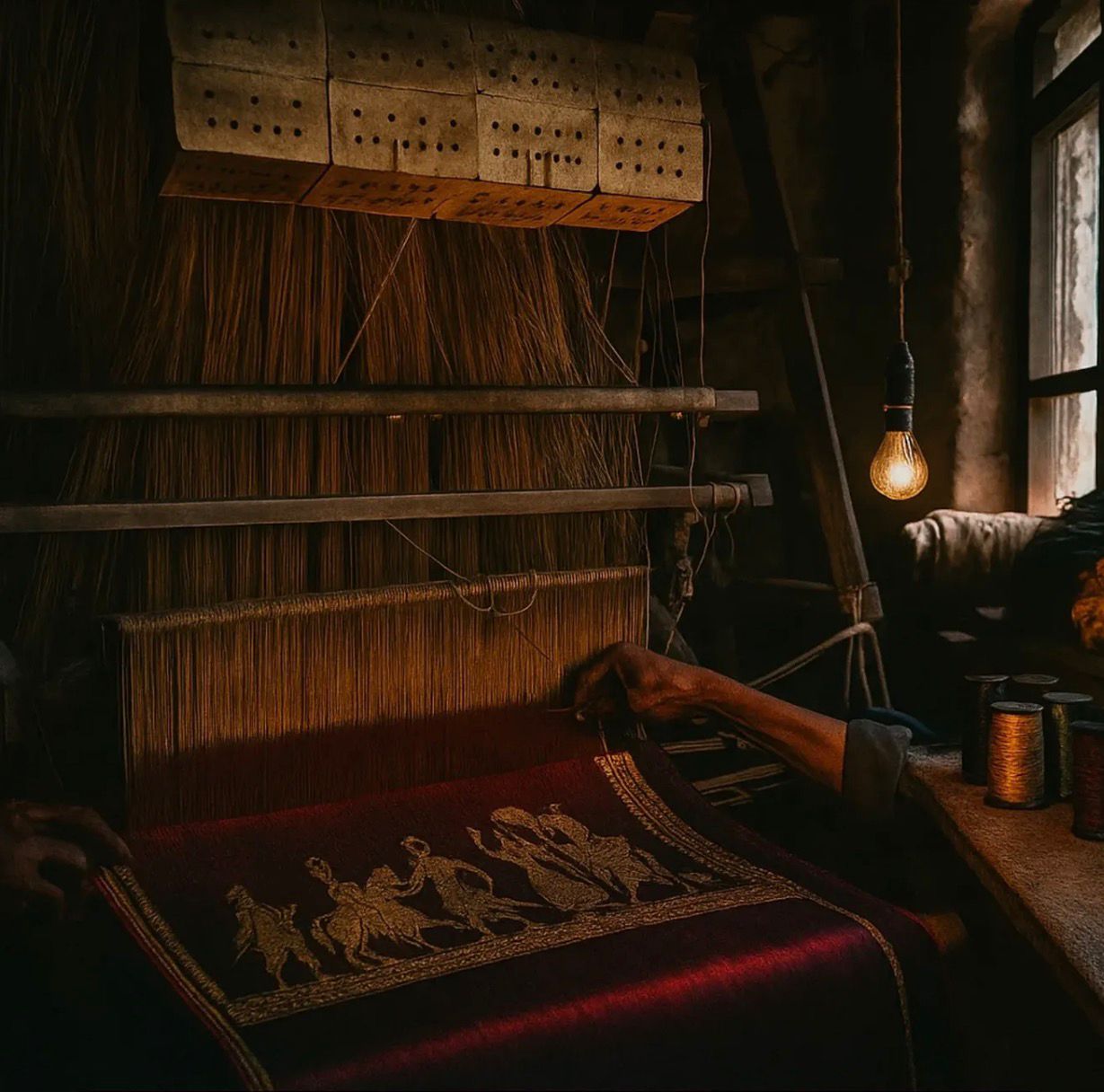
In the 18th and 19th centuries, the authentic Baluchari sarees from Murshidabad were crafted using traditional jala looms. Here, 'jala' signifies the reference design created initially, serving as the master template from which numerous copies can be repetitively woven into sarees. This intricate process was quite time-consuming, requiring between 15 to 18 weeks to complete a single saree, resulting in a wide array of complex patterns. During the 20th century, the revival of Baluchari weaving led by artist Subho Thakur saw the transition from jala to the jacquard weaving technique. In this method, the design is first sketched on graph paper and then punched into cards accordingly. These cards are arranged in sequence, sewn together, and ultimately fixed into jacquard machines. Although the jacquard technique is more straightforward and expedites the weaving process to just 1 or 2 weeks, it lacks the flexibility of the jala technique and cannot create patterns with the same level of diversity or detail. This modern technique is now employed for weaving Baluchari sarees.

01
Baluchari sari


bottom of page